Blog / Conway Ford Dealer

Understanding Ford Dashboard Lights

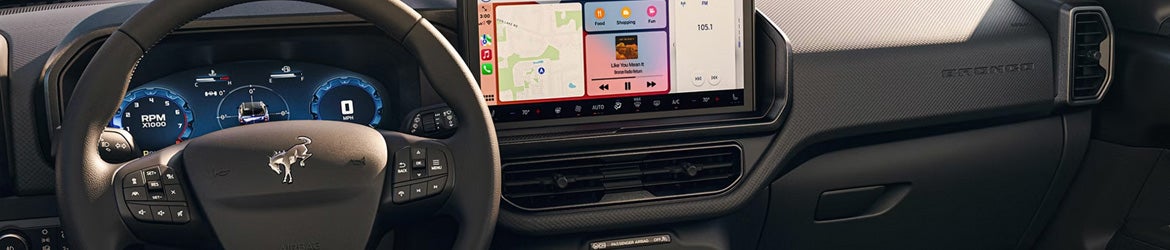
Ford interior dashboard display

Your vehicle communicates important information through dashboard lights and symbols. When a warning or indicator appears on the instrument cluster, it is designed to keep you safe and informed. Understanding what each light means and knowing when to take action can help maintain your vehicle’s health and prevent potential issues.

The Color Coding System for Ford Drivers 

Ford dashboard lights use colors to show importance. Red lights are the most serious. These show that a system needs immediate attention. Yellow or amber lights serve as a caution. These lights mean a driver should pay attention soon, but they may not require a driver to pull over immediately. 

Green and blue lights are informational. These show that a system or a feature is currently active. White lights also show that a feature is in use. This system is the 1st step toward reading icons with confidence. 

Common Red Ford Dashboard Warning Lights 

Red icons require immediate action. The oil pressure warning light looks like an oil can. It means the engine may not have enough oil pressure. If this light turns on while driving, safely pull over and check the oil level as soon as possible. 

The battery warning light looks like a battery. It shows that the vehicle may not be charging correctly. This could mean a problem with the alternator, the battery, or the electrical system. The engine temperature warning light looks like a thermometer in water. It signals that the engine is overheating. This condition requires immediate care to prevent engine damage. The brake system warning light shows an exclamation mark in a circle or the word BRAKE. This can mean the parking brake is on, or it can signal low brake fluid. 

Common Yellow and Amber Ford Dashboard Lights 

Yellow icons mean a driver should take note. These do not always require immediate action, but they require a check soon. The check engine light looks like an engine. It can mean a loose gas cap or a complex engine issue. A diagnostic scan is the best way to find the cause. 

The tire pressure monitoring system light looks like a flat tire with an exclamation mark. Check the air pressure in all 4 tires when this light appears. Proper inflation helps with safety and fuel efficiency. The transmission temperature warning light shows that the fluid is too hot. Avoid heavy towing until the system cools down. 

Informational Ford Dashboard Lights 

Many lights simply show that a system is working. Ford Co-Pilot360 technology indicators are 1 example. These lights appear when features like lane keeping or automatic braking are active. This means the technology is working as intended. 

A blue light shaped like a snowflake shows that the outside temperature is near or below 32 degrees. This is a helpful notice rather than a warning. Lights for turn signals or high beams also fall into this category. 

Identifying When to Get Service 

Red lights mean the driver should stop and fix the issue. Yellow lights mean the driver should schedule a service visit soon. Green or blue lights mean a feature is active. The owner manual is a good source of information for these symbols. Drivers can also contact the service team at Conway Ford. The staff can provide a professional inspection so the driver can travel with confidence. 
Posted in:

Related Posts

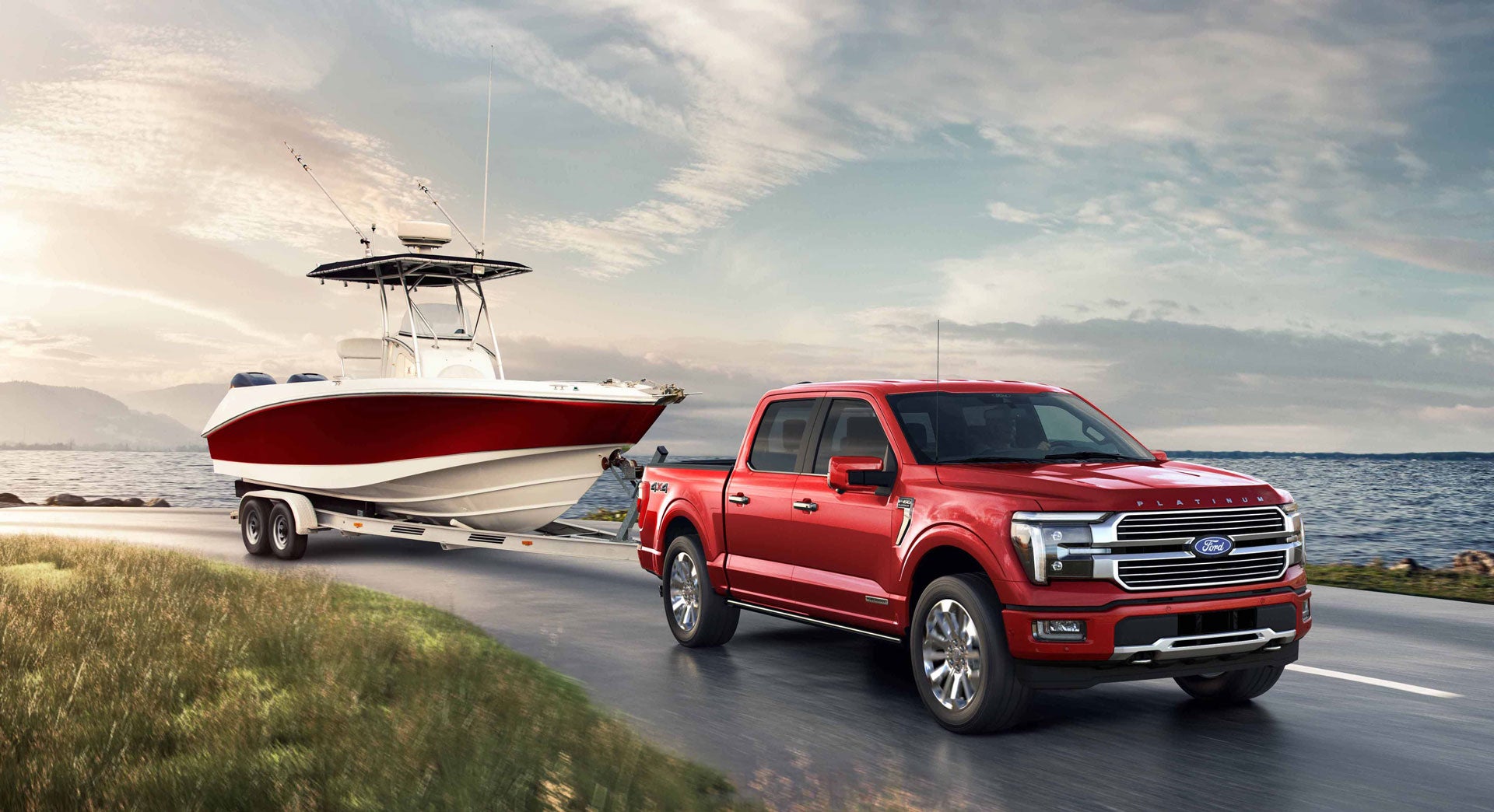
Red Ford F-150 towing boat along waterfront

Ford Trucks for Towing a Boat

Best Ford Trucks for Towing a Boat: A Guide to Ford Truck Towing Capacity Ford trucks are renowned for their towing muscle and durability—so if you’re shopping for a truck that can handle weekend trips to the lake or the coast, you’re in the right place. Now to narrow down how much towing capacity you need and which Ford truck is best for the job. The 2026 Ford lineup includes several capable options, from the compact Maverick to the heavy-hitter Super Duty, and the right choice depends on how much your boat and trailer weigh combined. Here's a closer look at the best Ford truck in this year’s lineup for towing a boat around Conway, South Carolina. The 2026 Ford F-150: The All-Around Pick For most boat owners, the F-150 is the first truck that springs to mind—and for good reason. The F-150 earned the title of #1 Large Light Duty Pickup in Initial Quality among full-size trucks in the JD Power awards, which is a reassuring sign for a truck you'll be putting to work regularly. It's available with a 430-hp hybrid powertrain, giving you flexibility depending on whether you want maximum pulling power or better efficiency on long hauls to the ramp. That powertrain comes with Pro Power Onboard™ so you can top off trolling motors or power up tools for maintenance. If you're frequently hooking up a midsize fishing boat or a ski boat in Conway, the F-150 is a well-rounded platform that covers most trailering needs of up to 13,300 lbs., without requiring you to step up to a heavy-duty truck. The 2026 Ford Ranger: Compact but Capable If your boat is on the lighter side - think a jon boat, a small bass boat, or a personal watercraft trailer - the 2026 Ford Ranger might be your fit. The Ranger is a midsize truck able to tow up to 7,500 lbs., and it's easier to maneuver in tight boat ramp parking lots compared to a full-size. If you want a solidly capable towing partner without the bulk of an F-150, the Ranger hits a practical middle ground. The Ranger Raptor® trim adds upgraded suspension and off-road hardware, which can be useful if your favorite ramp is at the end of a rough dirt road. The 2026 Ford Super Duty: Built for the Big Hauls When your trailer weight goes up - larger pontoon boats, cabin cruisers, or multi-boat setups - the Super Duty is the answer. The Super Duty also earned the number one ranking for new-vehicle quality among heavy-duty trucks from JD Power, reaffirming its strength. The F-250 and F-350 configurations are engineered specifically for heavy towing work, able to pull up to 28,000 lbs., and the High-Output Power Stroke® V8 diesel engine makes it easy. It boasts Best-in-Class 500 hp matched by Best-in-Class torque of 1,200 lbs.-ft., giving it the low-end grunt you need alongside efficiency. If towing capability is your top priority and you need serious numbers to handle a large vessel, the Super Duty lineup is where that conversation starts. There's a reason contractors and serious sportsmen alike rely on it. The 2026 Ford Maverick: Light-Duty Towing on a Smaller Footprint Don't overlook the Maverick if your trailering needs are modest. This compact pickup’s engine options start with a standard 2.5L hybrid powertrain, giving you 42/35 city/highway MPG, and is designed for drivers who want truck utility in a smaller setup. The Maverick can tow between 2,000 and 4,000 lbs. depending on the package, and it’s significantly easier to park and drive daily. If you have a kayak trailer, a small aluminum fishing boat, or a paddleboard setup, the Maverick could be all the truck you need. Find the Right Truck for Your Trailer at Conway Ford Whether you're pulling a 16-ft. bay boat or a full-size pontoon through Conway, SC, there's a truck in the 2026 Ford lineup built for the job. Talking to a team member here at Conway Ford who understands Ford truck towing capacities and boat-hauling needs will help you match the right truck to your actual trailer weight—and avoid buying more or less truck than you need. Visit https://www.conwayfordinc.com/ to explore the current inventory and find the perfect truck for your next day on the water.

Blue Ford Bronco Sasquatch driving rugged terrain

2026 Ford Bronco Sasquatch Package Guide

2026 Ford Bronco® Sasquatch® Package: What Those 35-Inch Tires Really Get You There's something wonderfully excessive about a factory-built SUV wearing 35-inch tires. But the 2026 Ford Bronco® Sasquatch® Package isn't simply an exercise in looking intimidating at the grocery store. Behind those enormous tires is a collection of mechanical upgrades designed to improve traction, clearance, and control. For Conway, SC, drivers tackling sandy trails and muddy backroads, understanding that hardware is the difference between buying capability and buying an appearance package. The Sasquatch® Hardware: More Than Bigger Tires The package includes 35-inch rugged-terrain tires on 17-inch wheels, high-clearance fender flares, and electronic-locking front and rear differentials. A 4.7 final-drive ratio helps manage the larger tires and supports controlled low-speed driving. High-clearance suspension components provide additional room for wheel movement and challenging terrain. Specific wheels and suspension equipment vary by configuration, but the underlying objective remains consistent: improve the Bronco's ability to negotiate obstacles without surrendering traction. Suspension Engineering Makes the Difference On applicable configurations, Sasquatch® includes HOSS 2.0 suspension with Bilstein® position-sensitive dampers. These dampers respond to suspension movement, helping control compression and extension over uneven ground. Larger tires and increased ride height also improve clearance and off-road approach, departure, and breakover geometry. That's important when crossing deep ruts or climbing uneven obstacles. However, Sasquatch® doesn't install identical suspension hardware on every Bronco. Existing trim equipment determines the final configuration. Why Two Locking Differentials Matter Imagine climbing a muddy incline with one wheel spinning helplessly while the opposite wheel has traction. An open differential can create precisely that frustration. Electronic-locking differentials help both wheels on an axle rotate together, improving traction when the surface becomes uneven. Sasquatch® provides front and rear lockers, a substantial advantage during demanding trail driving. Combined with available low-range 4WD gearing and selectable G.O.A.T. Modes®, they give drivers greater control over difficult terrain. Lockers should be engaged only under appropriate conditions and according to Ford's instructions. Sasquatch® Versus Badlands® and Raptor® Sasquatch® availability varies across the 2026 Bronco lineup. Badlands® already carries specialized trail equipment, making a careful comparison of its existing hardware important. Raptor® is another animal entirely, featuring HOSS 4.0 suspension, FOX™ Live Valve dampers, and 37-inch all-terrain tires. Its equipment is engineered around a different level of off-road performance. Before selecting Sasquatch®, examine the complete factory configuration instead of assuming the package adds the same components to every trim. Turbocharged Engines Still Do the Heavy Lifting The available 2.3L EcoBoost® 4-cylinder produces up to 300 hp and 325 lbs. ft. of torque with premium fuel. Compatible configurations offer a 7-speed manual or 10-speed automatic transmission. The available 2.7L EcoBoost® V6 produces up to 330 hp and 415 lbs. ft. of torque with premium fuel, paired with a 10-speed automatic. Sasquatch® doesn't increase engine output. Its contribution comes from helping the Bronco put available power to work across challenging surfaces. Is Sasquatch® Worth the Trade-Off? For regular encounters with deep sand, rocks, and heavily rutted trails, the package offers meaningful mechanical advantages. The trade-offs include potentially increased road noise, reduced fuel economy, and different pavement ride characteristics. Drivers spending nearly all their time on highways may prefer a conventional Bronco. Serious off-road enthusiasts, however, will appreciate equipment engineered for conditions beyond ordinary pavement. Explore the 2026 Bronco® at Conway Ford The Sasquatch® Package transforms the Bronco through traction hardware, larger tires, and specialized suspension components. Visit Conway Ford in Conway, SC, to compare available Sasquatch® configurations and examine their equipment. Schedule a test drive to find the Bronco® that matches your off-road ambitions and everyday driving needs.

2026 Ford interior with touchscreen and leather seats

2026 Ford F-150 XLT vs Lariat

2026 Ford F-150® XLT vs. Lariat®: How Much Luxury Does a Pickup Need? A pickup earns its reputation by doing difficult jobs without complaint. But after a long day hauling equipment or traveling South Carolina highways, a comfortable cabin begins to seem less like an indulgence. That's the distinction between the 2026 Ford F-150® XLT and Lariat®. Both offer serious capability, but they approach the business of driving with different priorities. For Conway, SC, buyers, the interesting question is how much additional comfort makes sense. XLT: The Working Truck with Modern Manners The XLT starts with a 2.7L EcoBoost® V6 producing 325 hp and 400 lbs. ft. of torque. Available alternatives include the 5.0L V8, 3.5L EcoBoost® V6, and 3.5L PowerBoost® Full Hybrid V6. Inside, a 12-inch SYNC® 4 touchscreen, 12-inch digital instrument cluster, and wireless Apple CarPlay® and Android Auto™ compatibility provide contemporary convenience. Available heated front seats and trailering technology broaden its appeal. It's a capable truck that doesn't demand an elaborate equipment package to feel well appointed. Lariat®: Comfort Becomes Part of the Assignment The Lariat® begins with the stronger 3.5L EcoBoost® V6, generating 400 hp and 500 lbs. ft. of torque. The 5.0L V8 and PowerBoost® hybrid remain available. Inside, ActiveX™-trimmed seating, heated and ventilated front seats, a heated steering wheel, dual-zone automatic climate control, and premium audio make a persuasive case for upgrading. Ventilated seats, in particular, earn their appreciation during humid South Carolina summers. The Lariat® isn't simply dressed more extravagantly; it provides equipment drivers can appreciate throughout a long commute. Engines and Towing: Look Beyond the Trim Badge The available 5.0L V8 produces 400 hp and 410 lbs. ft. of torque, while the PowerBoost® hybrid delivers 430 hp and 578 lbs. ft. of torque. Every engine uses a 10-speed automatic transmission. Across the broader F-150® lineup, maximum towing reaches 13,500 lbs. when properly equipped. Individual XLT and Lariat® ratings depend on drivetrain, axle ratio, cab, engine, and equipment. Available Pro Trailer Backup Assist™ and Pro Trailer Hitch Assist™ can simplify compatible trailer maneuvering and alignment. For serious towing, the exact truck's specifications count more than its trim designation. Technology: Where the Lariat® Pulls Ahead Both trims feature SYNC® 4, wireless smartphone integration, and Ford Co-Pilot360® driver-assistance technology, including features such as Pre-Collision Assist® with Automatic Emergency Braking and Blind Spot Information System. Lariat® adds access to available BlueCruise hands-free highway driving on designated compatible roads. BlueCruise requires an attentive driver and applicable service plan. Available Head-Up Display and upgraded camera technology provide further convenience. Connected services through the Ford Connectivity Package may require additional subscriptions. Choosing the Truck You'll Appreciate Every Day The XLT makes sense for buyers prioritizing capability, technology, and equipment flexibility. Its available engines and 4WD configurations accommodate demanding work without requiring the Lariat's premium appointments. The Lariat® appeals to drivers who spend substantial time behind the wheel and value standard heated and ventilated seating, additional cabin comforts, and available BlueCruise. Neither trim automatically guarantees a higher towing rating. Compare specific configurations, especially when optional packages alter their capabilities. Compare the 2026 F-150® at Conway Ford The XLT delivers the essentials of a modern full-size pickup, while the Lariat® adds comfort that can make long hours on the road considerably more pleasant. Visit Conway Ford in Conway, SC, to examine available F-150 trims, equipment, and towing configurations. Schedule a test drive in both trims to discover which F-150® suits your work and driving preferences.